
Communication Challenges in Airport Environments
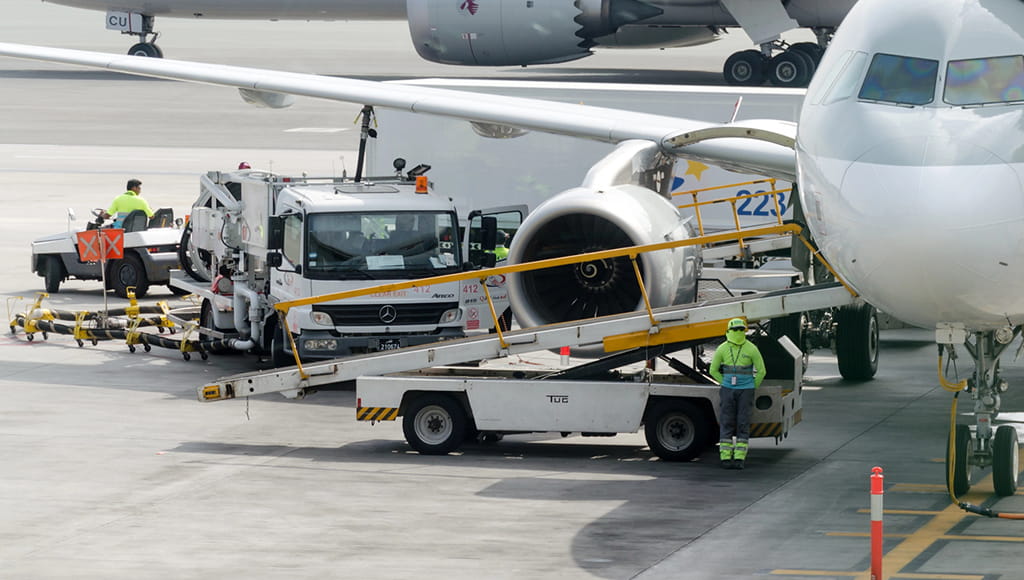
Airport ground operations involve some of the most demanding communication conditions encountered in any commercial environment. Teams work across large open areas, jet bridges, taxiways, ramps, cargo facilities, and maintenance bays — often simultaneously and under time pressure. Engine noise, wind, and constant equipment movement create persistent interference with voice communication.
Reliable push-to-talk radio communication is critical in this environment because coordination failures directly affect flight schedules, ground crew safety, and aircraft handling procedures. A missed or unclear message during fueling, towing, or gate management can have immediate operational consequences.
Factors influencing reliable radio communication in aviation ground environments include:
- High ambient noise levels from jet engines, ground support equipment, and apron activity require radios with effective noise-canceling microphone technology
- Wide coverage requirements across terminals, ramps, hangars, and cargo areas — often spanning several hundred thousand square feet
- Structural interference from terminal buildings, jetways, and aircraft fuselages that can create radio shadow zones
- Multi-team coordination between ground handling, fuel crews, gate agents, operations control, and maintenance requires channel discipline and often multi-channel capability
- Shift continuity demands durable, long-battery-life equipment capable of full-shift operation under outdoor conditions
- Regulatory environment — aviation ground communication operates within an environment subject to airport authority and FAA operational requirements; radio equipment selection should account for applicable local policies
How Two-Way Radios Are Used in Aviation Ground Operations

Push-to-talk radio communication is the established standard for aviation ground crew coordination across U.S. airports. The immediacy of PTT communication — no dialing, no hold time — makes it the practical choice for time-sensitive operations where voice confirmation is required before or during aircraft handling.
Two-way radios in aviation ground environments are typically applied across a range of coordinated tasks involving multiple crew members and departments. The common thread is the need for fast, reliable, hands-free-capable voice communication that does not depend on cellular infrastructure.
 Aircraft pushback and towing
Fueling operations -
Gate management
Baggage and cargo handling
Maintenance coordination
De-icing operations
Emergency response and FOD control
Aircraft pushback and towing
Fueling operations -
Gate management
Baggage and cargo handling
Maintenance coordination
De-icing operations
Emergency response and FOD control
Recommended Aviation Ground Radio System Setups
Configuration choices for aviation ground operations are typically driven by the size and layout of the facility, the number of teams requiring simultaneous communication, and the noise levels present on the ramp. Smaller regional airports and FBOs often operate effectively with portable-only configurations, while larger commercial facilities commonly incorporate mobile units and repeater infrastructure to ensure ramp-wide coverage.
The setups below represent examples of configurations commonly used in aviation ground environments. They reflect typical operational conditions and are intended to illustrate equipment categories and system logic, not to define a fixed specification.
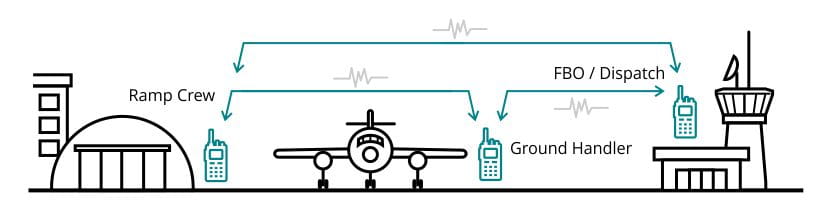
Setup A — Portable-Based Configuration (Single Terminal / FBO / Regional Airport)
Equipment: Professional-grade portable two-way radios with noise-canceling speaker-microphone capability; UHF or VHF depending on site frequency coordination
Accessories: Remote speaker-microphones (essential for ramp use), aircraft-rated headsets for high-noise positions, multi-unit gang chargers for shift-start readiness, carry cases rated for outdoor/ramp conditions
Why this works: A portable-only setup is well-suited to compact ramp environments where coverage distances are manageable and crews remain within a defined operational zone. UHF frequencies typically provide better penetration around aircraft fuselages and terminal structures. Noise-canceling speaker-microphones address the communication clarity challenge on active ramps without requiring crews to bring the radio to their face.
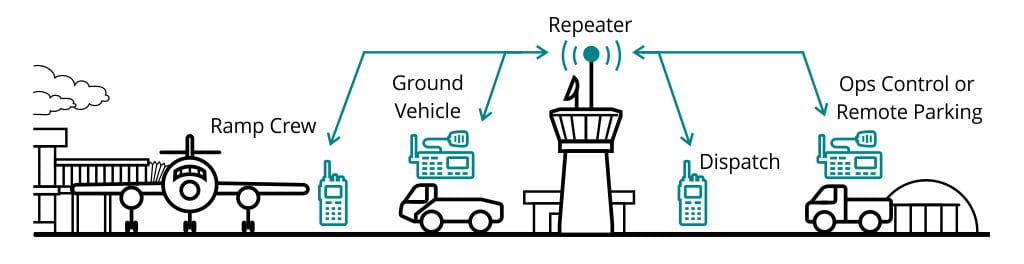
Setup B — Portable + Mobile + Repeater Configuration (Multi-Gate / Hub Operations)
Equipment: Professional-grade portable radios for ground crew; vehicle-mounted mobile radios for operations vehicles and tugs; repeater system to extend coverage across terminals, cargo facilities, and remote parking areas
Accessories: Remote speaker-microphones, headset stations for dispatch and operations control positions, vehicle antenna kits for mobile units, UPS-backed repeater infrastructure
Why this works: Large commercial airports typically require layered communication infrastructure. Mobile radios on ground support vehicles provide higher transmit power and extended range compared to handhelds. Repeater systems address the shadow zones created by terminal structures and parked aircraft. This approach allows a single radio system to serve ramp crews, operations vehicles, and fixed dispatch positions within a consistent channel plan.
Both setups represent examples of proven configurations, based on typical operational requirements, and may be adapted within the conditions of a specific operating site. Configurations are based on equipment from professional-grade manufacturers including Icom, Hytera and Motorola Solutions — brands supplied and supported by AXDIGITAL LLC.
Long-Range Communication in Aviation Ground Operations
Coverage performance in airport environments is shaped by a combination of frequency selection, antenna placement, and physical site characteristics. Open ramp areas generally support reliable portable-to-portable communication over moderate distances, while enclosed terminal corridors and multi-story parking structures present more significant propagation challenges.
UHF frequencies are commonly selected for ramp and terminal environments because of their behavior around metal structures and vehicles. VHF may be considered for large open areas such as cargo aprons or remote parking fields where line-of-sight conditions are more consistent. The operational layout of the airport — including the number and position of terminal buildings, the presence of underground facilities, and the distance between gate areas and cargo operations — directly influences how the radio system should be structured.
Repeater infrastructure helps extend communication coverage across large or structurally complex airports. Antenna placement and system design for repeater-based networks are typically coordinated with the airport authority and account for site-specific frequency coordination. Communication performance is further influenced by channel loading — the number of simultaneous users — and the radio equipment's power output rating.
Guidance, Coordination, and Documentation Support
AXDIGITAL LLC provides assistance with radio system selection based on the operational requirements of airport and aviation ground environments. Our role includes guidance on equipment categories, system configuration options, and coordination with the documentation requirements of the procurement process.
- Support services include:
- Radio system selection assistance help identifying equipment suitable for ramp, terminal, maintenance, and cargo communication requirements
- Configuration guidance discussion of portable, mobile, and repeater-based approaches based on the size and structure of the operating environment
- Documentation support assistance with equipment specifications, system descriptions, and procurement documentation as required by airport operations or facilities management
- Warranty and post-warranty service ongoing service and repair support for equipment supplied by AXDIGITAL LLC
- Coordination with operational requirements guidance on how radio system structures typically align with multi-department communication needs in aviation ground environments
We do not provide licensing services, do not act as a regulatory representative, and do not assume responsibility for obtaining permits or licenses. Radio frequency coordination and FCC licensing, where applicable, are the responsibility of the operating organization.
Frequently Asked Questions
What type of two-way radios are commonly used in aviation ground operations?
Professional portable radios with noise-canceling speaker-microphones are the standard choice for ramp crew in most ground handling environments. Larger airports commonly supplement portables with vehicle-mounted mobile radios on ground support equipment and repeater infrastructure to maintain coverage across the full operating area.
How far can aviation ground crew two-way radios communicate?
Communication range depends on frequency type, antenna configuration, and the physical environment. In open ramp areas, professional portable radios typically support reliable communication over several hundred feet to a mile or more. Structural interference from terminals, jet bridges, and aircraft fuselages can significantly reduce effective range, which is why repeater systems are commonly used at larger facilities to maintain consistent coverage.
What accessories are recommended for aviation ramp radio systems?
Remote speaker-microphones are considered standard equipment for ramp use, allowing crews to communicate without removing the radio from a belt clip or vest. Headset systems are typically used at dispatch and operations control positions. High-capacity batteries and multi-unit charging stations are commonly specified to support full-shift operation without mid-shift charging requirements.
Can two-way radios operate reliably inside airport terminals and enclosed facilities?
Yes, professional-grade radios are commonly used in terminal corridors, gate areas, baggage claim, and maintenance bays. However, enclosed structures — particularly those with significant concrete, steel framing, or underground sections — can reduce signal penetration and range. System configurations for indoor or mixed indoor/outdoor environments typically account for these conditions through frequency selection, repeater placement, or distributed antenna approaches.
Request a Recommended Aviation Ground Radio Setup
Get Guidance on Aviation Ground Radio Configuration
Ground crew communication requirements vary by airport size, number of departments, and facility layout. Share your operational context and we'll help identify a radio system configuration that fits your environment.

Send your request and one of our team members will get back to you shortly.