Communication Challenges in Security Environments
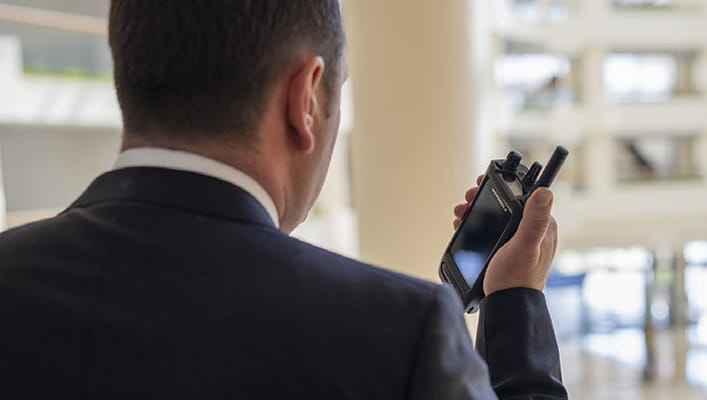
Security operations depend on communication that is immediate, consistent, and available at all times — regardless of facility size, shift conditions, or incident type. Officers and supervisors work across a wide range of environments: building interiors, parking structures, perimeter fencing, lobbies, loading docks, and outdoor patrol areas. Each presents its own set of radio propagation challenges.
Reliable push-to-talk radio communication is critical in security environments because response time directly depends on the speed and clarity of information exchange. A delayed or missed transmission during an access control breach, medical situation, or security incident can have serious consequences for personnel and the people they protect.
Factors influencing reliable radio communication in security operations include:
-
Security teams frequently move between open exterior areas and reinforced interior spaces such as parking garages, stairwells, and server rooms, where signal penetration varies significantly.
 Mixed indoor and outdoor coverage
-
Large campuses, multi-building complexes, and high-rise structures require radio systems that maintain coverage without dead zones across all patrol areas.
Facility size and layout
-
Around-the-clock shift operations require equipment with reliable battery performance and rapid recharging capability.
24/7 operational continuity
-
Certain security environments require low-profile equipment and earpiece-based communication to maintain a professional appearance and avoid alerting individuals under observation.
Discreet communication
-
Larger operations typically require separate channels for patrol, supervision, dispatch, and emergency escalation.
Multi-channel coordination
-
Some security environments use digital radio systems with logging capability to support incident reporting and post-event review.
Incident documentation and logging
How Two-Way Radios Are Used in Security Operations
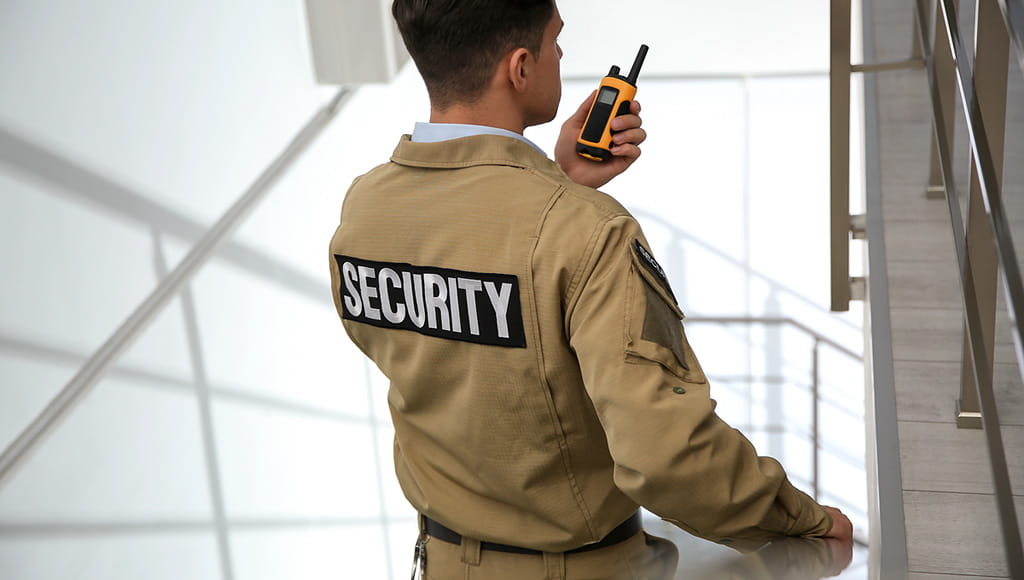
Push-to-talk radio communication has been the operational standard for professional security teams for decades. The ability to reach one person or an entire team instantly — without dialing, without a network connection, without delay — makes two-way radio the practical foundation of security coordination at facilities of any size.
Two-way radios in security environments are typically applied across a wide range of tasks that require real-time coordination between officers, supervisors, and dispatch. The common operational requirement is the ability to communicate immediately, in any location within the facility, at any point during the shift.
Patrol coordination
Access control
Incident response
Perimeter monitoring
YEscort and visitor management
Emergency and evacuation support
Shift handover coordination
Recommended Security Radio System Setups
Configuration choices for security operations are typically driven by the physical complexity of the facility, the number of officers per shift, and whether the operation requires discreet or high-visibility communication. Smaller single-site operations often work effectively with a straightforward portable radio system, while multi-building campuses and high-security environments commonly require repeater infrastructure and multi-channel programming.
The setups below represent examples of configurations commonly used in professional security environments. They reflect typical operational conditions and are intended to illustrate equipment categories and system logic, not to define a fixed specification.
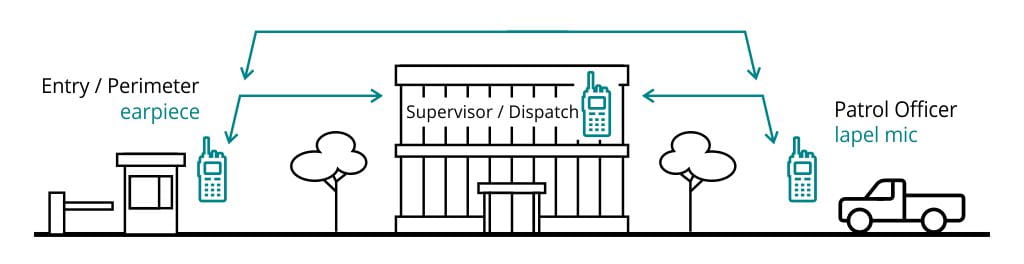
Setup A — Portable-Based Configuration (Single Site / Compact Facility / Small Security Team)
Equipment: Professional-grade portable two-way radios with long battery life; analog or digital (DMR) depending on operational requirements and existing infrastructure
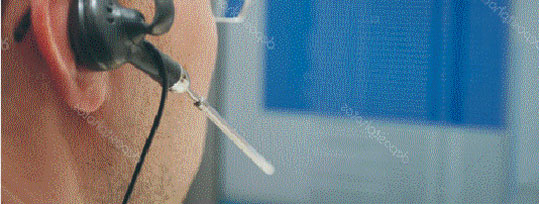
Accessories: Surveillance-style earpieces for discreet communication, lapel or shoulder microphones for hands-free operation, multi-unit charging racks for shift transitions, carry holsters rated for extended wear
Why this works: A portable-only setup is practical for security operations at single buildings, retail facilities, or compact campuses where coverage distances are manageable within direct or near-direct radio range. Digital (DMR) radios in this configuration provide cleaner audio at the edges of coverage compared to analog, which is relevant in stairwells and parking structures where signal may be marginal. Surveillance earpieces support a professional appearance while maintaining constant communication readiness.
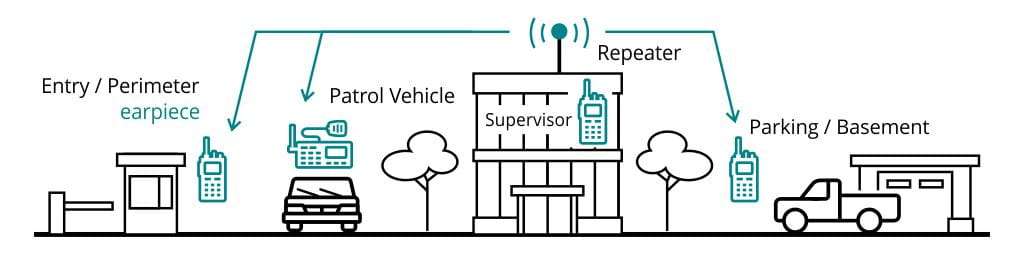
Setup B — Portable + Repeater Configuration (Multi-Building / Large Campus / High-Rise)
Equipment: Professional-grade portable radios programmed for multi-channel operation; UHF or 900 MHz repeater system deployed to address coverage gaps in reinforced structures, underground areas, and across campus perimeter
Accessories: RSurveillance earpieces, remote speaker-microphones for supervisors and outdoor patrol, vehicle-mounted mobile radios for patrol vehicles, UPS-backed repeater infrastructure
Why this works: Multi-building campuses, large industrial facilities, and high-rise structures present coverage challenges that portable-to-portable communication cannot consistently address. A repeater system extends effective range and eliminates dead zones in elevators, parking garages, and basement-level areas. Vehicle-mounted mobile radios on patrol vehicles provide extended transmit power for perimeter coverage. Multi-channel programming allows the operation to separate routine patrol traffic from supervisor, dispatch, and emergency channels.
Both setups represent examples of proven configurations, based on typical operational requirements, and may be adapted within the conditions of a specific operating site. Configurations are based on equipment from professional-grade manufacturers including Hytera, Motorola Solutions, and Icom — brands supplied and supported by AXDIGITAL LLC.
Long-Range Communication in Security Operations
Coverage performance in security environments is shaped by the physical construction of the facility and the frequency characteristics of the radio equipment selected. Open exterior areas — parking lots, perimeter fencing, and outdoor patrol routes — generally present fewer obstacles to radio propagation. Interior environments, particularly those with poured concrete, steel framing, or below-grade spaces, require more careful system planning.
UHF frequencies are commonly selected for mixed indoor/outdoor security environments because of their ability to penetrate building materials more effectively than VHF in most commercial construction scenarios. In high-rise buildings and underground facilities, distributed antenna systems (DAS) or in-building repeater configurations are sometimes used to maintain consistent coverage across all floors and levels.
Communication performance in large security deployments is also influenced by channel discipline — how many users are active on a single channel simultaneously. Digital radio systems provide more efficient use of available spectrum compared to analog, which can be relevant in larger teams where multiple simultaneous conversations are required. Repeater placement and antenna configuration for security operations are typically planned against a site map of the facility to identify coverage gaps before deployment.
Guidance, Coordination, and Documentation Support
AXDigital LLC provides assistance with radio system selection based on the operational requirements of professional security environments. Our role includes guidance on equipment categories, system configuration options, and coordination with the documentation requirements of the procurement process.
- Support services include:
- Radio system selection assistance Help identifying equipment suitable for patrol, dispatch, supervisor, and emergency communication roles within a security operation.
- Configuration guidance Discussion of analog vs. digital (DMR) approaches, channel planning, and repeater options based on the size and construction of the operating facility.
- Documentation support Assistance with equipment specifications, system descriptions, and procurement documentation as required by security management or facilities teams.
- Warranty and post-warranty service Ongoing service and repair support for equipment supplied by AXDigital LLC.
- Coordination with operational requirements Guidance on how radio system structures typically align with shift-based security operations, multi-team coordination, and incident response workflows
We do not provide licensing services, do not act as a regulatory representative, and do not assume responsibility for obtaining permits or licenses. Radio frequency coordination and FCC licensing, where applicable, are the responsibility of the operating organization.
Who Typically Uses These Systems
- Corporate campus and commercial real estate security operations
- Healthcare facility security and public safety departments
- Industrial facility and manufacturing plant security teams
- Retail loss prevention and asset protection operations
- Education campus security and public safety departments
- Event venues, stadiums, and entertainment complex security
- Government facility and institutional security operations
Frequently Asked Questions
What type of two-way radios are commonly used in professional security operations?
Professional portable radios — either analog or digital (DMR) — are the standard choice for security teams. Smaller single-site operations typically use portable-only configurations with surveillance earpieces and lapel microphones. Larger campuses and multi-building operations commonly add repeater infrastructure and, in some cases, vehicle-mounted mobile radios for patrol units. Digital radios are increasingly selected for their cleaner audio quality at coverage edges and their support for multi-channel operation.
How far can security team two-way radios communicate?
Communication range depends on frequency selection, the physical construction of the facility, and whether a repeater system is in use. In open exterior areas, professional portable radios typically support reliable communication over several hundred feet to a mile or more. Inside reinforced buildings — particularly in basement levels, stairwells, and parking structures — effective range may be significantly reduced without repeater support. Repeater systems are commonly used in large or structurally complex facilities to maintain consistent coverage across all patrol areas.
What accessories are recommended for security radio systems?
Surveillance-style earpieces are the standard accessory for most professional security environments, supporting discreet communication while maintaining officer awareness. Lapel or shoulder microphones allow hands-free operation during patrol and access control duties. For supervisors and outdoor-focused roles, remote speaker-microphones are commonly used. Multi-unit charging racks are typically specified to support shift transitions and ensure all radios are fully charged at the start of each shift.
Can two-way radios work inside parking structures, stairwells, and reinforced buildings?
Professional-grade radios operate in these environments, but signal penetration and range are influenced by construction materials and structural layout. Poured concrete, steel framing, and below-grade spaces can reduce effective coverage compared to open areas. In facilities where consistent interior coverage is operationally critical, repeater systems or in-building distributed antenna configurations are typically used to address these gaps. System planning for security deployments in complex structures generally involves mapping coverage requirements against the facility layout before specifying equipment.
Request a Recommended Security Radio Setup
Get Guidance on Security Radio Configuration
Security communication requirements vary by facility type, team size, and operational structure. Share your site conditions and we'll help identify a radio system configuration suited to your security operation.
Send your request and one of our team members will get back to you shortly.