Reliable radio communication is a critical component of marine operations, where work is carried out in high-noise conditions, complex environments, and with limited opportunities for visual coordination between operational teams. Professional two-way radio systems help maintain stable voice communication between crews, shore-based services, and operational personnel, supporting both safety and efficiency.
This page outlines the practical use of two-way radio systems for marine operations, the operational challenges they address, and typical approaches to configuring radio equipment used in ports and offshore environments. These solutions are presented by AXDIGITAL LLC, a supplier of professional radio communication equipment for the U.S. market.
Communication Challenges in Marine Environments
Marine environments impose specific requirements on radio communication systems. Unlike standard land-based conditions, several factors are often present simultaneously, each of which can significantly affect communication quality and reliability.
Key factors influencing reliable communication in marine operations include:

High Ambient Noise Levels
Operational noise from engines, deck equipment, wind, and weather conditions can significantly reduce speech intelligibility during marine operations.
Extended Communication Distances
Communication often takes place over large distances between participants, with limited line of sight when operating on open water or within port infrastructure.
Metal Structures and Signal Interference
Vessel hulls, onboard structures, and port facilities are typically constructed from metal, which can cause signal reflection, interference, and attenuation.
Moisture and Salt Exposure
Marine environments are characterized by continuous exposure to humidity and salt-rich air, increasing demands on the durability of radio equipment and accessories.
Operational Reliability Requirements
In marine operations, communication reliability is critical, as interruptions or failures can directly affect personnel safety and the continuity of operational processes.
Understanding these factors is essential when selecting appropriate marine two-way radio systems and developing functional, reliable equipment configurations.
How Two-Way Radios Are Used in Marine Operations
Professional two-way radios are used in marine operations in clearly defined working situations where fast and coordinated communication is required.
Typical communication scenarios include:
Vessel-to-Vessel Coordination
Two-way radios are used to maintain direct communication between multiple vessels during joint operations, maneuvering, or movement in confined or high-traffic areas.
On-Board Crew Communication
Radios support coordination among crew members on board a vessel, enabling communication between deck teams, engine rooms, and bridge personnel without reliance on visual contact.
Port and Dock Operations Coordination
Radio communication is commonly used to coordinate activities between port staff, infrastructure operators, and vessel crews during docking, loading, unloading, and servicing operations.
Offshore Operation Team Communication
In offshore environments, two-way radios provide reliable communication between teams working across remote marine areas, offshore facilities, or during service and maintenance activities.
In all of these scenarios, two-way radios for marine operations provide instant voice communication without reliance on cellular networks or external communication infrastructure.
Recommended Marine Radio System Setups
Marine operations typically rely on proven radio system configurations that have been validated in practice and adapted to common operating conditions.
Below are examples of recommended marine radio system setups that can serve as reference points when selecting equipment.
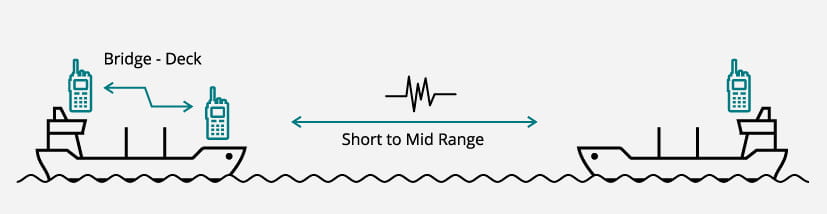
Setup A — Vessel Operations (Short to Mid Range)
This configuration is commonly used for communication within a single vessel or between multiple vessels operating at limited distances. Portable VHF radios with noise-cancelling capability are typically selected to ensure speech clarity in high-noise on-board conditions. Speaker microphones and carrying accessories are standard additions for deck and bridge crew, supporting push-to-talk operation without reliance on external communication infrastructure
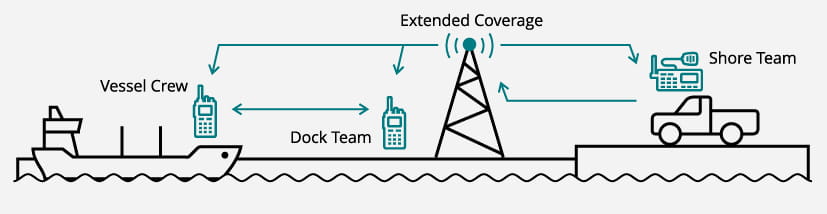
Setup B — Port and Extended Coverage Operations
For port areas and operations requiring wider coverage, a combination of portable and mobile VHF radios is commonly used. Mobile units with vehicle-mount kits are typically deployed for shore-based teams, while external antennas support extended signal coverage across larger operational areas. This configuration supports stable communication between vessels, dock teams, and port infrastructure operators across the full scope of port operations.
Both setups represent examples of proven configurations, based on typical operational requirements, and may be adapted within the conditions of a specific operating site. Configurations are based on equipment from professional-grade manufacturers including Hytera, Motorola Solutions, and Icom — brands supplied and supported by AXDIGITAL LLC.
Long-Range Communication in Marine Operations
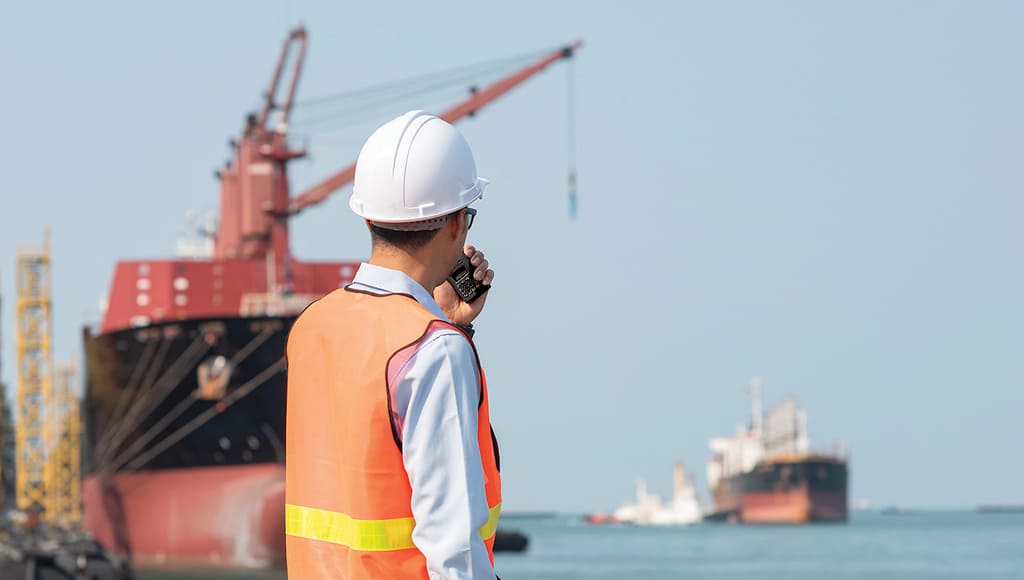
Communication range is a key consideration in marine operations. Long-range marine radio communication is achieved through a combination of factors rather than a single technical component.
Communication performance and stability are influenced by:
- the selection of frequency bands appropriate to signal propagation conditions;
- environmental characteristics and open-space operating conditions;
- proper placement of radio equipment and antennas;
- independence from congested public communication networks.
Well-configured marine two-way radio systems help maintain stable voice communication over extended istances, which is especially important for port and offshore operations.
Guidance, Coordination, and Documentation Support
In addition to supplying equipment, AXDIGITAL LLC provides support within clearly defined, legally appropriate frameworks, contractual obligations, and manufacturer technical recommendations.
When working with two-way radio systems for marine operations, we offer:
- assistance with radio selection based on operational needs;
- guidance on system configuration;
- coordination with customer operational requirements;
- documentation support;
- warranty and post-warranty service.
We do not provide licensing services, do not act as a regulatory representative, and do not assume responsibility for obtaining permits or licenses.
Who Typically Uses These Systems
These solutions and standard configurations are commonly used across various segments of the marine industry, including:
- Marine operations
- Ports & terminals
- Offshore service teams
- Marina management
Each of these segments has specific operational characteristics and communication requirements. Detailed approaches may be addressed on dedicated industry pages or recommended by AXDIGITAL LLC specialists upon request.
Request a Recommended Marine Radio Setup
If you need to select a marine two-way radio system that matches your operating conditions, you can request a recommendation or discuss your operational requirements with a specialist.
AXDIGITAL LLC can help identify an appropriate approach based on your environment, operational tasks, and the scale of marine operations.

Send your request and one of our team members will get back to you shortly.
Frequently Asked Questions
What type of two-way radios are used in marine operations?
Marine operations typically rely on portable and mobile VHF radios designed for use in demanding environments. Equipment from professional-grade manufacturers such as Icom is commonly selected for marine applications due to its established reputation in this segment. AXDIGITAL LLC supplies and supports Icom radio equipment for marine operations.
How far can marine two-way radios communicate?
Communication range in marine operations depends on several factors, including frequency band selection, antenna placement, and environmental conditions. In open-water conditions, well-configured VHF radio systems can support communication over extended distances. Operational range may vary significantly depending on vessel type, surrounding infrastructure, and equipment configuration.
What accessories are recommended for marine radio systems?
Accessories for marine radio systems are typically selected based on operational role and environment. Speaker microphones are commonly used for deck and bridge communication, while vehicle-mount kits and external antennas are often applied in port and mobile installations. Carrying accessories and protective cases are generally recommended for portable radios used in high-moisture marine conditions.
Can two-way radios work in offshore environments?
Two-way radios are widely used in offshore environments for team coordination, safety communication, and operational management. Equipment selected for offshore use is typically chosen for its durability in high-humidity and salt-exposure conditions. Portable and mobile radio configurations can support reliable communication across offshore facilities and service teams.