Communication Challenges in Logistics Environments

Warehouses, distribution centers, and freight terminals are high-throughput environments where receiving, picking, packing, and outbound operations run simultaneously across large footprints. Workers cover significant ground on foot and by forklift, often in facilities that span hundreds of thousands of square feet across multiple levels, mezzanines, and dock bays.
RF propagation in these environments is shaped by factors common to logistics facilities: dense steel racking, reinforced concrete decking, metal roll-up dock doors, and the mass of palletized inventory in pick aisles. These materials absorb and reflect signal in ways that reduce effective PTT range well below open-area performance — sometimes dramatically in deep cooler sections and narrow aisle runs.
Factors influencing reliable radio communication in logistics operations include:
-
Single-building DCs and multi-building campus layouts both require coverage planning across all operational zones, including yard areas beyond the building perimeter.
 Large facility footprints
-
Tall steel shelving in narrow pick aisles creates RF shadowing that cuts portable-to-portable range significantly compared to open floor performance.
Metal racking and inventory density
-
Communication between indoor floor operations and outdoor yard trucks, spotters, and gate staff requires a system that handles the indoor-to-outdoor transition without a coverage gap.
Dock and yard coordination
-
Forklifts, conveyor systems, dock levelers, and HVAC equipment generate sustained background noise that affects audio intelligibility; speaker-mic placement and radio audio profile selection matter.
Ambient noise
-
DCs typically run two or three shifts with staggered starts; battery runtime and fast-charge turnaround directly affect operational readiness at shift change.
Multi-shift operations
-
Floor associates, lift operators, receiving clerks, supervisors, and yard spotters all operate on the same radio infrastructure, which requires a channel plan that separates traffic by function without overcomplicating day-to-day use
Cross-functional coordination
How Two-Way Radios Are Used in Logistics Operations

Push-to-talk radio is the backbone of floor-level coordination in distribution and warehousing. Unlike messaging apps or overhead PA systems, PTT puts voice communication in a worker's hand with one button — no unlock screen, no typing, no waiting. In a DC running thousands of picks per shift, that immediacy directly affects throughput.
Two-way radios in logistics environments are typically applied across tasks that require real-time coordination between workers in different zones of the same facility, or between indoor operations and the yard outside. The common requirement is fast, hands-free-capable communication that keeps people moving.
Receiving and inbound dock coordination
Pick and replenishment coordination
Outbound staging and load verification
Forklift and equipment dispatch
Yard management
Supervisor and floor management
Maintenance and facilities coordination
Recommended Logistics Radio System Setups
Configuration choices for logistics operations are typically driven by facility size, the number of operational zones that need to communicate simultaneously, and how much of the operation extends into the yard or across multiple buildings. Smaller single-shift warehouses often run effectively on a portable-only system. High-volume DCs and multi-shift operations commonly need repeater coverage to maintain PTT connectivity across the full footprint.
The setups below represent examples of configurations commonly used in warehouse and distribution environments. They reflect typical operational conditions and are intended to illustrate equipment categories and system logic, not to define a fixed specification.
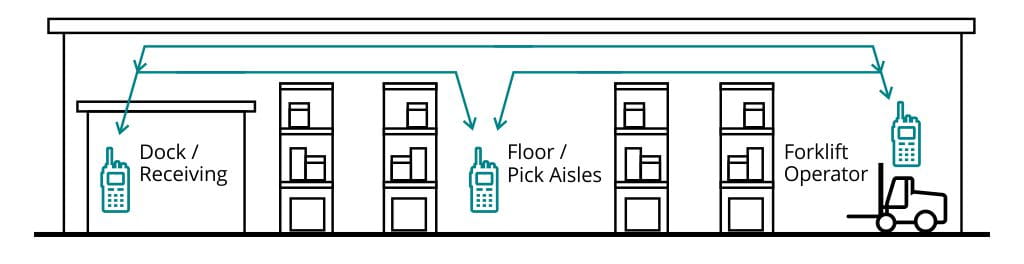
Setup A — Portable-Based Configuration (Single-Building Warehouse / Smaller DC)
Equipment: Professional-grade portable two-way radios with high-capacity battery packs; analog or digital (DMR) depending on existing infrastructure and channel requirements
Accessories: Remote speaker-microphones for hands-free operation on the floor and dock, multi-unit gang chargers sized for full fleet turnover at shift change, carry holsters or chest harnesses compatible with PPE and hi-vis vests
Why this works: A portable-only setup covers most single-building warehouse operations where the floor plan is relatively open and pick aisle depth doesn't push radios into deep RF shadow. Speaker-mics keep workers hands-free during pick and putaway without reaching for the radio body. High-capacity batteries sized for 10–12 hour runtime eliminate mid-shift swap logistics in single-shift operations. DMR digital radios provide cleaner audio at the edges of coverage — useful in cooler sections and dock areas where signal is marginal.
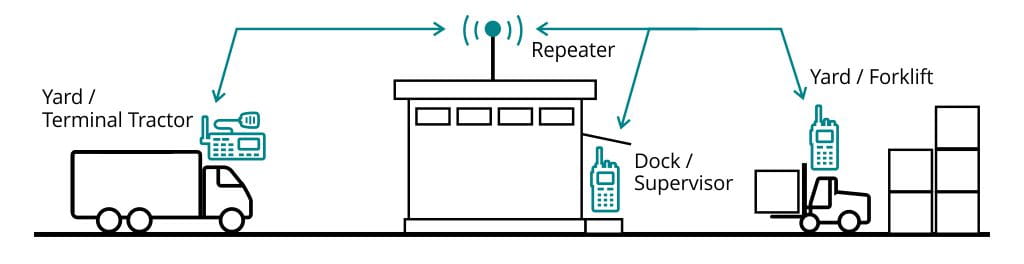
Setup B — Portable + Repeater Configuration (Large DC / Multi-Building / Yard Operations)
Equipment: Professional-grade portable radios programmed for multi-channel operation; UHF repeater system deployed to extend coverage across deep pick aisles, mezzanine levels, cooler sections, and yard areas; vehicle-mounted mobile radios for yard trucks and terminal tractors
Accessories: Remote speaker-microphones, vehicle antenna kits for yard equipment, multi-unit charging infrastructure for large fleets, UPS-backed repeater hardware
Why this works: High-cube DCs with dense racking, multi-level mezzanines, and active yard operations expose the coverage limits of portable-to-portable radio. A repeater brings the full facility — including cooler sections, below-dock areas, and the yard — into a single consistent coverage footprint. Mobile radios on yard trucks and terminal tractors provide the transmit power needed for reliable communication at range in open yard environments. Multi-channel programming separates floor, dock, yard, and supervisor traffic, which reduces channel congestion during peak throughput windows.
Both setups represent examples of proven configurations, based on typical operational requirements, and may be adapted within the conditions of a specific operating site. Configurations are based on equipment from professional-grade manufacturers including Hytera, Motorola Solutions, and Icom — brands supplied and supported by AXDIGITAL LLC.
Long-Range Communication in Logistics Operations

Coverage performance in warehouse and DC environments is shaped by the interaction between radio frequency characteristics and the physical structure of the facility. Open floor areas between racking rows typically support reliable portable-to-portable communication. The challenge comes from RF shadowing in deep pick aisles, signal attenuation through concrete mezzanine decking, and the transition between the conditioned interior and the open yard outside.
UHF frequencies are the common selection for warehouse and DC environments because UHF handles the mix of metal racking, concrete, and loading dock steel better than VHF in most facility construction types. In high-bay facilities with racking above 30 feet, vertical RF behavior becomes a factor — antenna placement on repeater infrastructure needs to account for coverage at both floor level and elevated pick positions on order selectors or reach trucks.
Yard coverage adds a different set of variables. Open yard areas support longer PTT range from mobile radios on yard trucks, but the transition from yard to dock interior can create a coverage gap if the system isn't planned for it. Repeater antenna positioning and the use of directional or omnidirectional antennas at dock-level locations are typically part of how this transition zone is addressed in larger facilities.
Guidance, Coordination, and Documentation Support
AXDIGITAL LLC provides assistance with radio system selection based on the operational requirements of warehouse, distribution, and freight environments. Our role includes guidance on equipment categories, system configuration options, and coordination with the documentation requirements of the procurement process.
- Support services include:
- Radio system selection assistance Help identifying equipment suited to floor operations, dock coordination, yard management, and supervisor communication roles.
- Configuration guidance Discussion of analog vs. digital (DMR) approaches, channel planning for multi-function operations, and repeater options based on facility size and layout.
- Documentation support Assistance with equipment specifications, system descriptions, and procurement documentation as required by operations management or facilities teams.
- Warranty and post-warranty service Ongoing service and repair support for equipment supplied by AXDIGITAL LLC.
- Coordination with operational requirements Guidance on how radio system structures typically align with multi-shift DC operations, cross-functional team communication, and yard-to-floor coordination workflows.
We do not provide licensing services, do not act as a regulatory representative, and do not assume responsibility for obtaining permits or licenses. Radio frequency coordination and FCC licensing, where applicable, are the responsibility of the operating organization.
Who Typically Uses These Systems
Two-way radio communication in logistics applies across a wide range of facility types — not just large national DCs. Warehouses, 3PL operations, freight terminals, and fulfillment centers share the same core coordination challenge: workers spread across large footprints, time-sensitive handoffs between receiving, floor, dock, and yard, and supervisors managing exceptions across multiple zones simultaneously. The organizations below represent the primary operational contexts where professional PTT radio systems are commonly selected.
- Warehouse and distribution center operations
- Third-party logistics (3PL) providers
- Freight terminals and cross-dock facilities
- Cold storage and refrigerated distribution operations
- E-commerce fulfillment centers
- Manufacturing plant logistics and internal material handling
- Port and intermodal terminal ground operations
Frequently Asked Questions
What type of two-way radios are commonly used in warehouse and distribution operations?
Professional portable radios with remote speaker-microphones are the standard setup for floor associates, dock staff, and supervisors in most DC environments. Analog radios cover straightforward single-channel operations, while digital DMR radios are commonly selected when operations need multiple channels, cleaner audio at coverage edges, or compatibility with existing digital infrastructure. Yard trucks and terminal tractors typically use vehicle-mounted mobile radios for the additional transmit power needed in open yard environments.
How far can two-way radios communicate inside a warehouse or DC?
In open floor areas, professional portable radios typically support reliable PTT communication across several hundred feet. In deep pick aisles with dense steel racking, effective range can drop significantly due to RF shadowing from the shelving and inventory mass. Facilities with high-bay racking, multi-level mezzanines, cooler sections, or large yard areas commonly use repeater systems to maintain consistent coverage across the full operational footprint.
What accessories are recommended for logistics radio systems?
Remote speaker-microphones are the standard accessory for warehouse floor use — they keep workers hands-free during pick, putaway, and receiving without reaching for the radio body. Carry holsters or chest harnesses compatible with hi-vis vests and PPE are commonly specified for comfort during extended shifts. High-capacity batteries and multi-unit gang chargers sized for the full radio fleet are typically part of the system spec for multi-shift operations where charge turnaround at shift change is operationally critical.
Can two-way radios maintain coverage in cooler sections and below-dock areas?
Coverage in cooler sections, freezer vaults, and below-dock areas depends on the construction of the space and the radio system configuration. These enclosed environments — particularly those with insulated metal panel walls — can reduce effective PTT range compared to open floor performance. In facilities where these areas are part of active operations, repeater systems with antenna placement planned for the specific layout are commonly used to maintain consistent coverage throughout the building..
Request a Recommended Logistics Radio Setup
Get Guidance on Logistics Radio Configuration
Radio system requirements vary by facility size, operational structure, and yard layout. Share your site conditions and we'll help identify a configuration suited to your distribution or warehouse operation.

Send your request and one of our team members will get back to you shortly.