
Icom IC-M330 Compact Fixed-Mount VHF Marine Radio (Black / White)
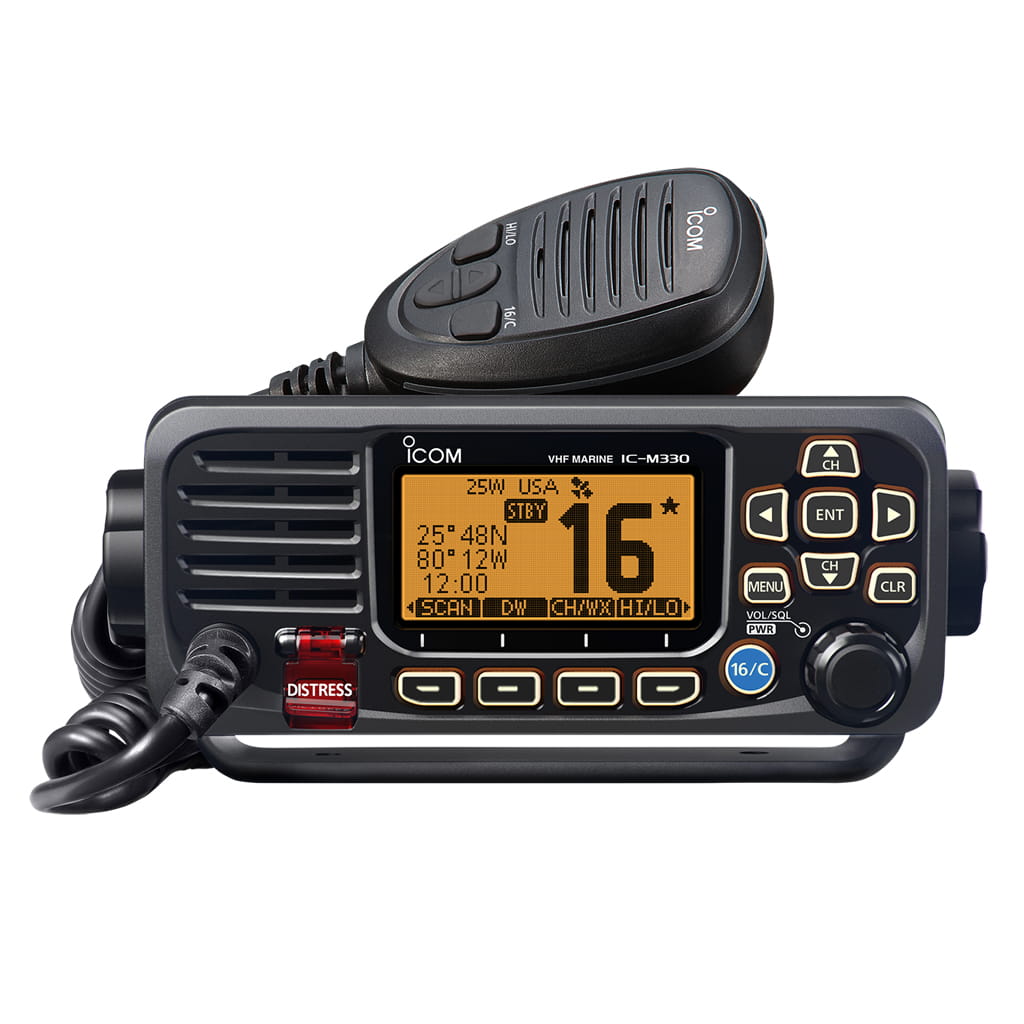
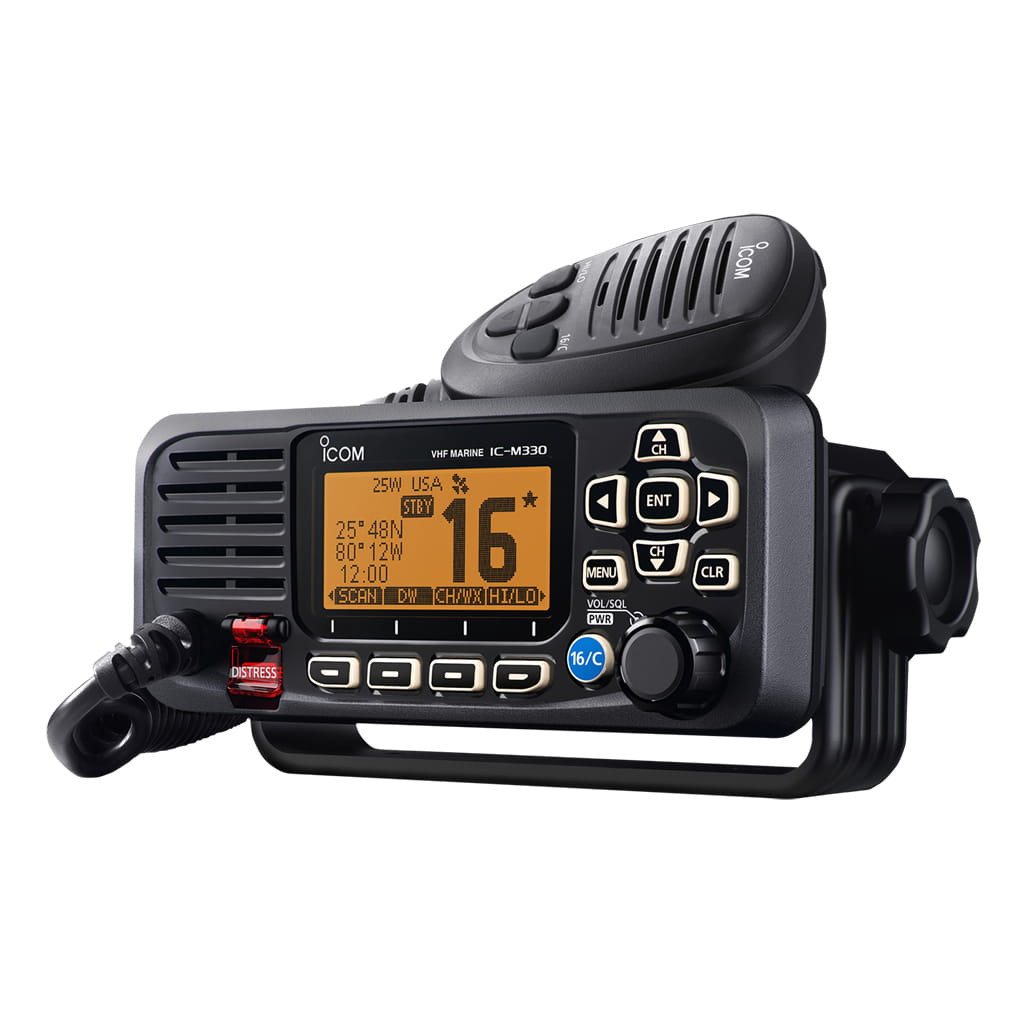

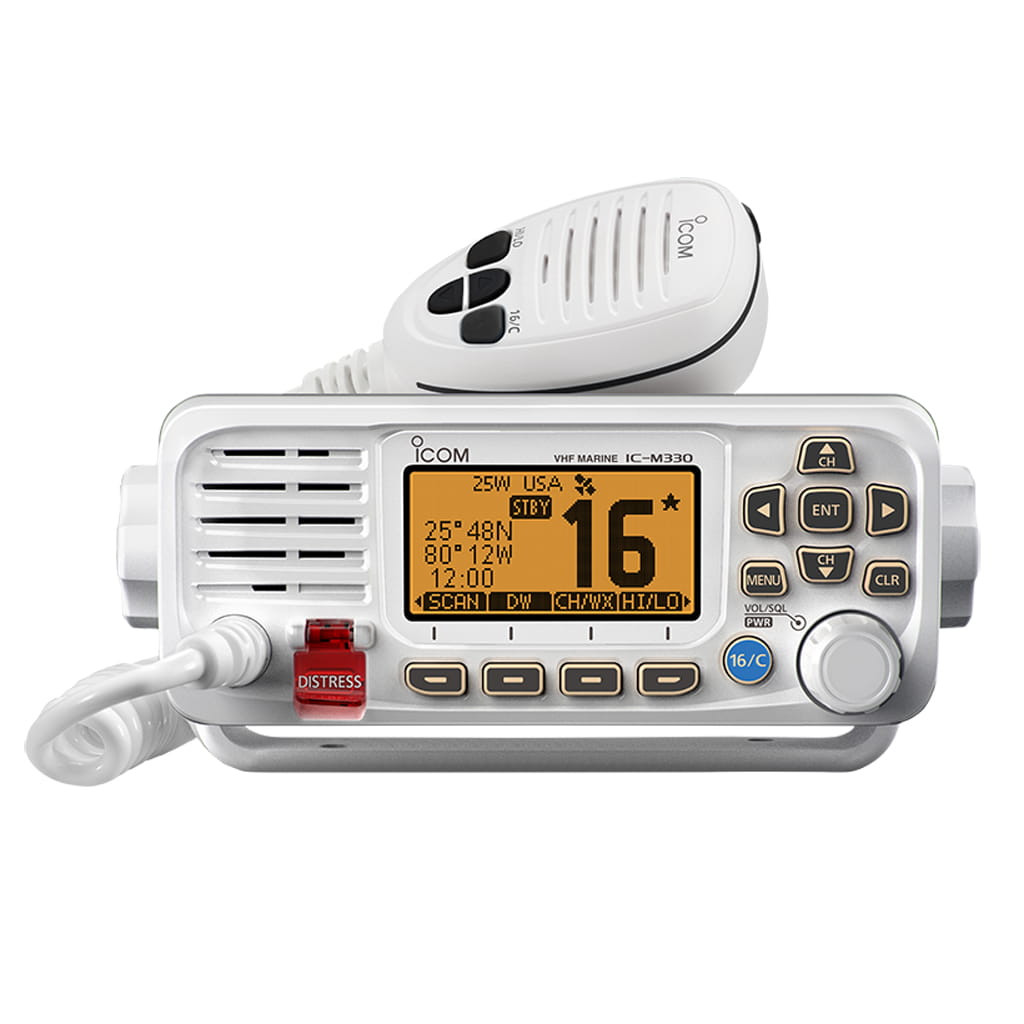
The Icom IC-M330 is a compact fixed-mount VHF marine radio for vessels with limited helm space. At 156.5×66.5×88.2mm and 730g, it delivers 25W output with Class D DSC, a dedicated CH70 receiver, IPX7 waterproofing, and AquaQuake™ speaker draining. Available in Black (M330 11) and White (M330 21) — both identical in specifications. Position data for DSC distress calls is supplied via NMEA 0183 from a connected chartplotter. For vessels without a chartplotter, the IC-M330G with built-in GPS is the recommended alternative.

Authorized Dealer

Fast Nationwide Shipping

Technical Support & Programming

Bulk Pricing Available
Why Professionals Choose the Icom IC-M330
The IC-M330 is a compact fixed-mount marine radio — 156.5×66.5×88.2mm, 730g — built for vessels where helm space is the primary installation constraint. Smaller center consoles, RIBs, trawlers with tight companionways, and sailboat nav stations benefit from the palm-sized chassis that fits where a standard fixed-mount unit cannot. The SO-239 connector accepts standard marine coax; the supplied bracket handles dash or bulkhead mounting, with the optional MBF-5 flush mount kit available for panel-flush installations.
RF output is 25W (Hi) / 1W (Lo) across USA, Canadian, and international VHF marine channels, including NOAA weather channels with weather alert. The dedicated CH70 receiver monitors Channel 70 for DSC calls continuously — even while the radio operates on a working channel. Class D DSC covers distress, individual, group, all ships, urgency, safety, position request/report, polling, and test calls. Adjacent channel selectivity and intermodulation both exceed 70 dB on the main receiver — class-leading performance for a compact fixed-mount at this price point.
AquaQuake™ vibrates the speaker grille to expel trapped water after wave wash or rain, preventing muffled audio on the first transmission after exposure. IPX7 protection covers submersion to 1 meter for 30 minutes. Audio output is 4.5W typical into a 4Ω load — sufficient for open helm stations without an external speaker in most conditions.
Position data for DSC distress calls comes via NMEA 0183 input from a connected chartplotter (RMC, GGA, GNS, GLL, VTG accepted). NMEA output sends DSC event data and position sentences back to the chartplotter. The IC-M330 is also compatible with the Icom MA-500TR Class B AIS transponder for integrated AIS display and DSC calling from AIS targets. Vessels without a chartplotter or NMEA GPS source should specify the IC-M330G, which adds a built-in GPS/GLONASS/SBAS receiver. FCC Part 80 certified for USA VHF marine operation.
Specification
General
| Frequency Range TX | 156.025–161.600 MHz | |
| Frequency Range RX | 156.050–163.275 MHz | |
| CH70 (DSC) | 156.525 MHz | |
| Usable Channels | USA, CAN, INT, WX channels | |
| Type of Emission | 16K0G3E (FM) / 16K0G2B (DSC) | |
| Power Supply | 13.8V DC | |
| Current Drain TX (25W) | 5A | |
| Current Drain RX AF max | 1A | |
| Operating Temperature | –20°C to +60°C | |
| Antenna Impedance | 50Ω (SO-239) | |
| Dimensions (W×H×D) | 156.5×66.5×88.2 mm | |
| Weight (approx.) | 730g | |
Transmitter
| Output Power | 25W / 1W |
| Max Frequency Deviation | ±5 kHz |
Receiver
| Sensitivity — Main (12 dB SINAD) | –13 dBμ typ. |
| Sensitivity — DSC (1% BER) | –5 dBμ emf typ. |
| Squelch Sensitivity | <–10 dBμ |
| Adjacent Channel Selectivity — Main | >70 dB |
| Adjacent Channel Selectivity — DSC | >73 dBμ emf (1% BER) |
Compliance
| FCC Certification | FCC Part 80 — VHF Marine Radio |
| IP Rating | IPX7 (submersible 1m / 30 min) |
| DSC Class | Class D (ITU-R M493) |
| AIS Compatibility | Icom MA-500TR Class B AIS transponder |
FCC Licensing and Compliance Support
The Icom IC-M330 is FCC Part 80 certified for USA VHF marine channels. For recreational vessels operating exclusively on domestic USA inland and coastal waters, no operator license is required to use the radio. A Restricted Radiotelephone Operator Permit is required when operating on international waters or at foreign ports.
DSC distress calling requires an MMSI (Maritime Mobile Service Identity) number programmed into the radio before the distress function is active. For USA recreational vessels, MMSI registration is free through BoatUS (www.boatus.com/mmsi) or Sea Tow. Commercial vessels register MMSI through the FCC directly. The MMSI is a unique 9-digit number tied to your vessel and cannot be changed without an FCC filing.
On the IC-M330, position coordinates embedded in a DSC distress call come from a connected chartplotter via NMEA 0183 input. If no NMEA source is connected, position must be entered manually at the time of the call. For vessels where chartplotter connectivity is not available or reliable, the IC-M330G with built-in GPS provides a fully independent position source for DSC calls regardless of other electronics aboard.
As an authorized Icom marine dealer, AXDIGITAL assists customers with FCC Part 80 requirements and MMSI registration guidance. Contact our team before installation to confirm the correct configuration for your vessel type and operating area.
FAQ
What is the difference between the IC-M330 and IC-M330G?
The IC-M330G has a built-in GPS/GLONASS/SBAS receiver with a supplied external puck antenna. The IC-M330 has no built-in GPS — it relies on NMEA 0183 input from a chartplotter for position data in DSC calls. If your helm has a chartplotter with NMEA output already connected, the IC-M330 is sufficient. If your vessel has no chartplotter or you want a position source that works independently of other helm electronics, specify the IC-M330G.
Does the color choice affect any specification?
No. The M330 11 (Black) and M330 21 (White) are identical in all RF specifications, DSC features, dimensions, weight, and protection rating. The only practical difference is the supplied hand microphone: HM-235B (Black) or HM-235W (White).
Can the IC-M330 be used without a chartplotter?
Yes - it will transmit and receive on all marine VHF channels and monitor CH70 for DSC calls. However, a DSC distress call sent without a connected NMEA GPS source will not automatically include your vessel's position coordinates. The Coast Guard will receive the DSC alert but without location data, which delays search and rescue response. For vessels without chartplotter connectivity, the IC-M330G with built-in GPS is strongly recommended.
