


Communication Challenges on Construction Sites
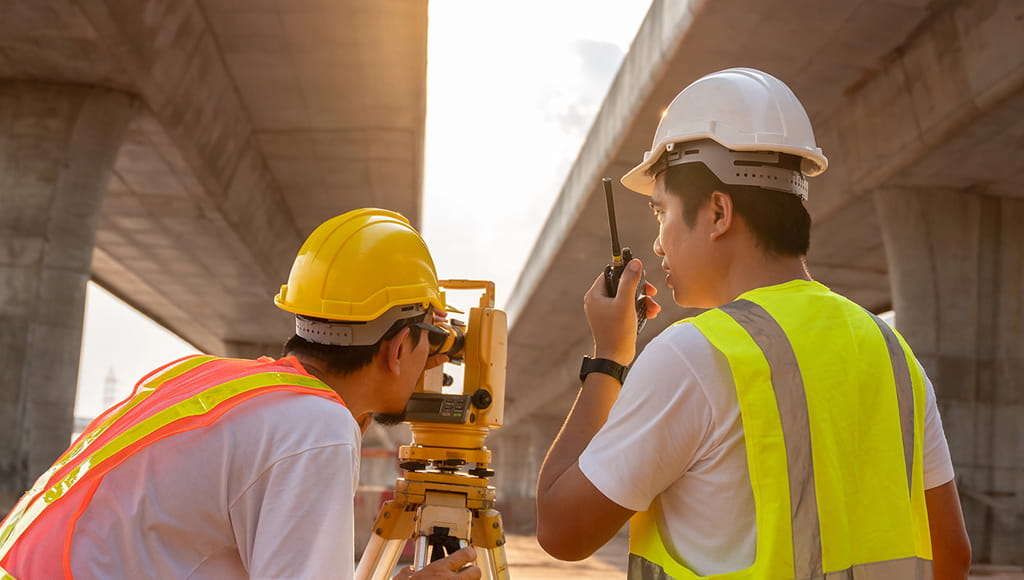
Working conditions on a construction site change with the type of structure being built and the stage of the work. Open ground, trenches, multi-level structures, heavy equipment, and plain distance across the site cut down the chances for direct communication between workers. Crews and individual tradespeople of different specialties need to reach each other across the whole site, where cellular coverage is often unreliable. Crane signaling, the loading and handoff of materials, and safety alerts all run up against heavy background noise. In these conditions, a reliable Two-Way Radio System within the site is critical, since push-to-talk communication keeps the crews coordinated. Radio Systems for Construction bring real benefits, but a few factors affect what they can do.
Factors Affecting Communication Quality on a Job Site
- Constant equipment noise Excavators, concrete mixers, jackhammers, and cranes drown out voice traffic and cut down on crew communication.
- Spread-out, changing layouts Open excavations and trenches, laydown yards, and a site plan that shifts as the build goes on stretch or move the coverage area.
- Dense structures Scaffolding, rebar, steel framing, concrete floors, and below-grade work weaken the RF signal and create dead spots.
- Weather and rough handling Rain, dust, mud, temperature swings, knocks, and drops affect both signal propagation and the communication hardware itself.
- Safety and incidents Crane operations, heavy equipment, and emergencies such as a collapse, an injury, or an evacuation call for reliable, established communication channels.
How Two-Way Radios Are Used in Construction Operations
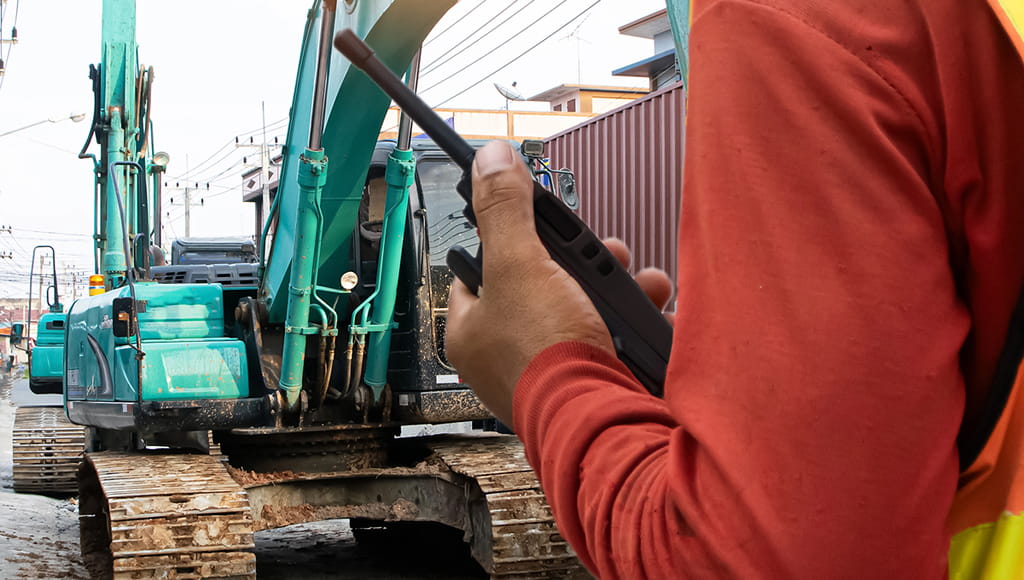
On a construction site, the main job of two-way radios and systems is to carry short, time-critical messages that keep deliveries, crews, and equipment in step. Push-to-talk is a proven approach for job sites: instant contact, hands-free operation for equipment operators, and coverage of a whole crew or several teams at once, with no reliance on the cellular network. Workers of every trade stay reachable without stepping away from the task, wherever they are, on the ground, on a floor, or up high. There are plenty of these everyday situations; the most telling ones follow.
Typical Ways Radios Are Used on Construction Sites
-
The ground crew and riggers guide the crane operator through each pick, keeping loads and people clear.
 Crane and lift signaling
-
Supervisors and foremen line up the engineering, electrical, building, and other crews as the work moves along.
Crew coordination across trades
-
Operators, drivers, and spotters coordinate excavators, loaders, and trucks around workers on the ground.
Equipment operation
-
Site staff schedule the delivery and handoff of materials, their storage, and gate access against the work plan.
Deliveries and gate control
-
On high-rise work, crews on different levels stay in contact in real time.
Multi-floor coordination
-
Immediate site-wide calls and alerts for incidents, collapses, or evacuation keep personnel safe.
Safety alerts
Recommended Construction Radio System Setups
In construction, the choice of two-way radio systems for construction comes down to the size of the site, the type of structure going up, and how far the crews are spread. A low-rise building, a high-rise with many levels, and a long infrastructure job each call for very different coverage. The approach is always specific to the site, but there are standard configurations that give you a starting point for selecting equipment. For example:
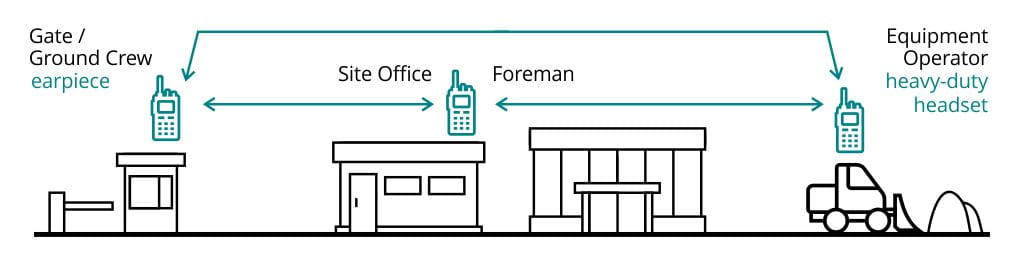
Setup A - Single Site (Short to Mid Range)
- Equipment: Urugged, industrial-grade UHF digital (DMR) portables with a high IP rating for dust, water, and drops.
- Accessories: heavy-duty remote speaker mics (RSM), noise-canceling headsets for equipment operators, spare high-capacity batteries, multi-unit chargers.
- Why this works: UHF radios hold up well around concrete and steel within a compact site. DMR audio stays clear in the noise of running equipment. On a single low-rise site, professional portables usually cover the work area with no added infrastructure.
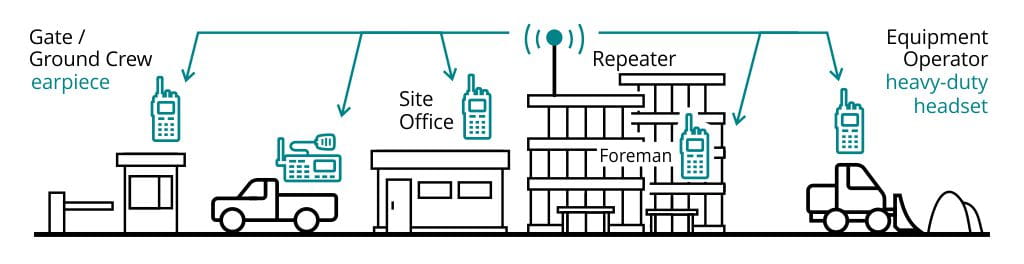
Setup B - Large or High-Rise Site (Extended Coverage)
- Equipment: industrial-grade UHF DMR portables with a repeater for site-wide coverage, plus mobile radios fitted to work vehicles where needed.
- Accessories: heavy-duty remote speaker mics (RSM), surveillance earpieces, vehicle mounts, external antennas, multi-unit chargers.
- Why this works: a repeater widens coverage across a spread-out site and extends it up through the floors of a high-rise, which reduces dead spots. Mounting mobile radios on vehicles gives steadier contact with their drivers, especially on large sites.
Both configurations above are examples of proven setups based on typical operational requirements, and they can be adapted to the conditions of a specific site. They are built around professional equipment from global manufacturers including Hytera, Motorola Solutions, and Icom which AXDIGITAL LLC supplies and services in the USA.
Equipment Recommended for the Construction sector
-
 Hytera PD482i UHF DMR Portable Professional Portable UHF, Professional (PD482i-Uv) Pro tier / lone worker | GPS+BT variant (PD482i-G-BT-Uv) for man-down / tracking.View more
-
 Hytera BD552i UHF DMR Digital Portable Radio with Display Portable UHF, DMR, display (BD552i-U1) Mid crew / display. Business DMR with display, simple fleet.View more
-
 Hytera PD402i DMR Digital Portable UHF Portable UHF, DMR (PD402i-U1) Professional field. Compact professional handheld.View more
-
 Motorola CP200d MOTOTRBO UHF Portable Portable UHF, DMR/Analog (AAH01QDC9JA2AN) Standard crew radio. Industry-standard workhorse, IP54, loud audio, scalable fleet.View more
-
 Motorola XPR3500e MOTOTRBO Digital Portable UHF Portable UHF, display/keypad (AAH02RDH9VA1AN) Supervisors / foremen | Radio ID, text/status, full keypadView more
-
 Motorola XPR7550e UHF Portable Portable UHF, premium (AAH56RDN9RA1AN) Premium / management. IP68, ultra-clear audio, Bluetooth, long batteryView more
-
 Motorola XPR 5550e UHF Mobile Radio Mobile UHF, 25-40W (AAM28QPN9RA1AN) Vehicles / base (Setup B). In-vehicle and base station coverage.View more
-
 Hytera BD612i Rugged DMR Digital Portable UHF Rugged Portable UHF, DMR (BD612i-U1) Rugged value. Named for construction crews; tough budget option.View more
Long-Range Communication on Construction Sites
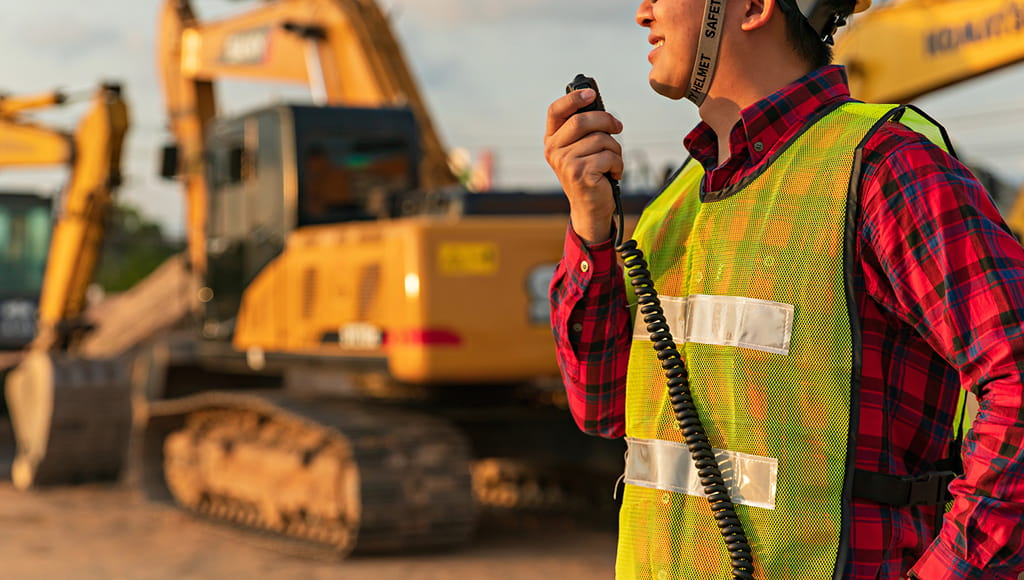
Communication range on a construction site depends on more than radio power; it also depends on choosing the right frequency band. UHF generally works better around concrete, rebar, and steel, while VHF can reach farther across open ground on infrastructure jobs. Structures, buildings, below-grade areas, and the site layout all affect how far a signal travels. A repeater placed to cover the active work areas helps extend coverage across the site and up through the floors, keeping communication going over a large area. Antenna placement and mounting height also affect how much of the site stays reachable.
Guidance, Coordination, and Documentation Support
Drawing on many years of experience, AXDIGITAL's specialists help you choose radio systems for construction that fit how your crews work and the conditions on a specific site. AXDIGITAL's services cover advice on system configuration, matching the equipment to your operational requirements, and documentation support for what we supply. Warranty and post-warranty service are provided for the radios and accessories we supply.
We do not provide licensing services, do not act as a regulatory representative, and do not assume responsibility for obtaining permits or licenses. Radio frequency coordination and FCC licensing, where applicable, are the responsibility of the operating organization.
Who Typically Uses These Systems
Two-way radios for construction sites are used on projects of different sizes and structure types. What they share is the need for instant coordination of crews across spread-out, noisy, and changing sites. The typical areas where these systems are in demand include:
- General contractors and construction management firms
- Residential and commercial construction
- Civil and infrastructure construction, including roadwork
- Concrete and frame structures and steel erection
- Crane and rigging operations
- Site safety and facilities teams
Frequently Asked Questions
What type of two-way radios are used on construction sites?
Most two-way radio systems for construction are built around rugged UHF digital (DMR) portables made for industrial use, with a high IP rating for dust, water, and drops. For noisy sites, models with strong audio are the usual choice. Mobile radios are often added for work vehicles.
How far can construction two-way radios communicate?
Range depends on the size of the site, the type of structure, and the frequency band. On a compact low-rise site, rugged portables usually cover the work area on their own. For large, spread-out, or high-rise sites, a portable repeater is the common way to extend coverage.
What accessories are recommended for construction radio systems?
Remote speaker mics and noise-canceling headsets are common where equipment noise is high. High-capacity batteries and multi-unit chargers keep radios running through long shifts. Vehicle mounts and external antennas are typically added for mobile use.
Can two-way radios work across a high-rise or below-grade site?
Yes, with the right setup. A portable repeater is the usual way to carry coverage up through the floors or into below-grade areas where portables alone hit dead spots. UHF generally works better than VHF around concrete and rebar.
Request a Recommended Construction Radio Setup
Tell us about your site: its size, the type of structure, and how your crews are spread across it. A specialist can put together a two-way radio setup to match those conditions.

Request a recommendation - Discuss your operational needs - Get guidance from a specialist

