


Communication Challenges in Manufacturing Environments
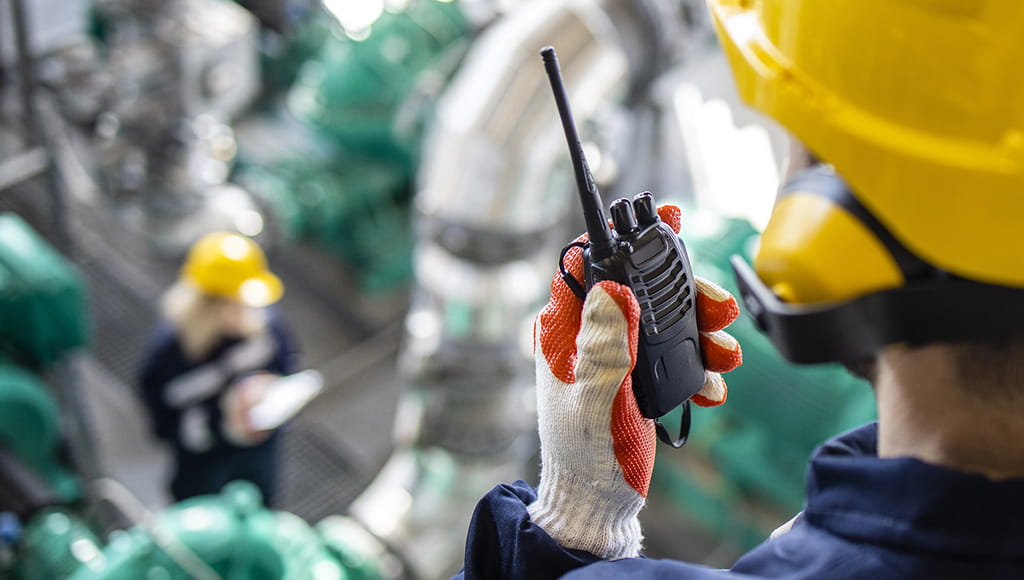
Manufacturing sites run high ambient noise, large footprints, and heavy metal structures that all work against clear radio communication. Production, maintenance, and material-handling teams need to reach each other without leaving their stations or stopping the line. Reliable push-to-talk communication is critical in these industrial environments, since it carries task handoffs, shift changes, breakdown response, and loading coordination. The factors that most influence communication performance on a plant floor are below.
Factors Affecting Communication Quality in Production Areas
- Mechanical obstructions Rows of metal racking, steel framing, and reinforced walls block line-of-sight and attenuate the RF signal.
- Constant equipment noise Presses, machine tools, conveyors, and forklifts mask voice traffic and cut down on operator communication.
- Production conditions Depending on the process, dust, heat, vibration, and moisture create harsh conditions for communication hardware.
- Large footprints Work areas across several buildings, racking, and outdoor yards stretch the coverage area.
- Safety and incidents Any stable process can fail (lockout, spills, evacuation), which from a safety standpoint demands reliable, established communication channels.
How Two-Way Radios Are Used in Manufacturing Operations

Across industrial plants, two-way radios synchronize the work of teams and production areas. A set of radios matched to the operation links areas and staff into a single communication scheme: instant contact, hands-free operation, and coverage of individual workers or whole groups at once. Workers at every level stay reachable without stepping away from their primary tasks. Typical scenarios include:
-
Production line coordination
Line leads communicate along the flow to avoid jams, retool in time, and pass or receive materials.
-
Maintenance dispatch
Operators report a breakdown; maintenance moves to the exact cell, and the relevant departments are kept updated on repair status.
-
Material handling
Forklift drivers and warehouse crews coordinate picks, put-aways, and moves, avoiding idle time and delays in the overall process.
-
Shift changeover
The outgoing supervisor passes current status (what is done, where the issues are, what is on watch) to the incoming one without a floor walk.
-
Shipping and receiving
Dock, terminal, and department staff align inbound and outbound loads with the line or adjacent units.
-
Safety alerts
mmediate and plant-wide calls for spills, lockout, or evacuation keep personnel safe.
Recommended Manufacturing Radio System Setups
On a manufacturing site, the choice of two-way radio systems for manufacturing comes down to facility size, noise levels, and how far teams are spread. A single production building, a multi-building campus, and a terminal with several open yards have very different coverage needs. The setups below reflect typical industrial conditions and serve as a starting point for equipment selection. Both can be adapted to a specific plant layout.
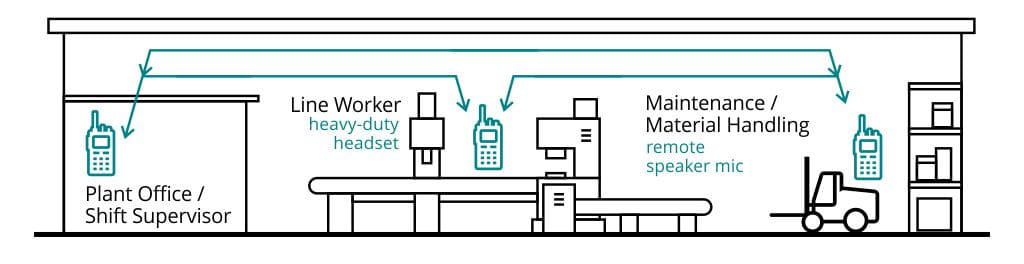

Setup A - Single-Facility Floor (Short to Mid Range)
- Equipment: UHF digital (DMR) portables, rated for high-noise and rugged duty.
- Accessories: heavy-duty noise-canceling headsets, remote speaker mics (RSM), spare high-capacity batteries, multi-unit chargers.
- Why this works: UHF penetrates indoor metal structures well, and DMR audio stays clear under machine noise where analog tends to break up. On a single building, portables typically cover the floor without added infrastructure.
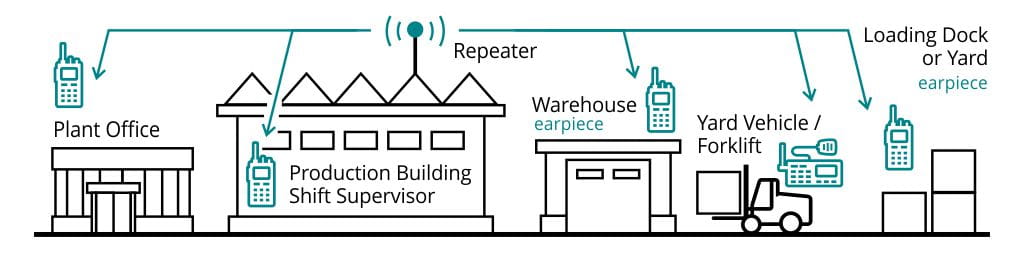
Setup B - Multi-Building Campus Extended Coverage
- Equipment: UHF DMR portables plus a repeater for site-wide coverage; mobile radios mounted in forklifts and yard vehicles where needed.
- Accessories: heavy-duty headsets, RSMs, vehicle mounts, external antennas, multi-unit chargers.
- Why this works: a repeater lifts coverage across separated buildings and outdoor yards that portables alone struggle to reach. Mobiles give material-handling crews a stronger link from moving equipment.
Both setups represent examples of proven configurations, based on typical operational requirements, and may be adapted within the conditions of a specific operating site. Configurations are based on equipment from professional-grade manufacturers including Hytera, Motorola Solutions, and Icom — brands supplied and supported by AXDIGITAL.
Recommended Two-Way Radios for Manufacturing
-
 Hytera BD552i UHF DMR Digital Portable Radio with Display Portable UHF, DMR, display (BD552i-U1) Mid crew / display. Business DMR with display, simple fleet.View more
-
 Hytera PD402i DMR Digital Portable UHF Portable UHF, DMR (PD402i-U1) Professional field. Compact professional handheld.View more
-
 Hytera PD482i UHF DMR Portable Professional Portable UHF, Professional (PD482i-Uv) Pro tier / lone worker | GPS+BT variant (PD482i-G-BT-Uv) for man-down / tracking.View more
-
 Motorola CP200d MOTOTRBO UHF Portable Portable UHF, DMR/Analog (AAH01QDC9JA2AN) Standard crew radio. Industry-standard workhorse, IP54, loud audio, scalable fleet.View more
-
 Motorola XPR3500e MOTOTRBO Digital Portable UHF Portable UHF, display/keypad (AAH02RDH9VA1AN) Supervisors / foremen | Radio ID, text/status, full keypadView more
-
 Motorola XPR7550e UHF Portable Portable UHF, premium (AAH56RDN9RA1AN) Premium / management. IP68, ultra-clear audio, Bluetooth, long batteryView more
-
 Motorola XPR 5550e UHF Mobile Radio Mobile UHF, 25-40W (AAM28QPN9RA1AN) Vehicles / base (Setup B). In-vehicle and base station coverage.View more
-
 Hytera BD612i Rugged DMR Digital Portable UHF Rugged Portable UHF, DMR (BD612i-U1) Rugged value. Named for construction crews; tough budget option.View more
Long-Range Communication in Manufacturing Operations
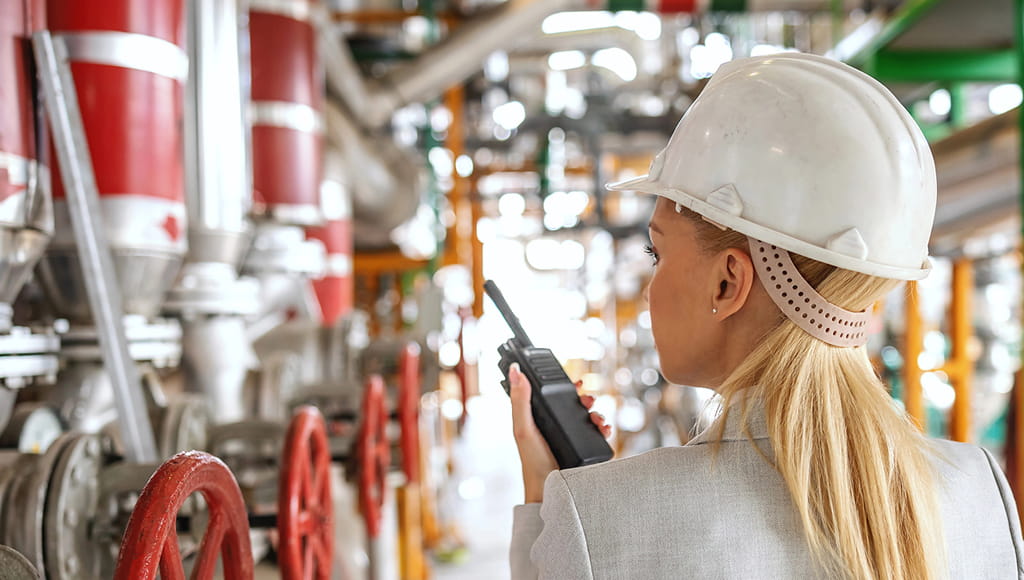
Communication range on a manufacturing site depends on more than radio power. Frequency band matters: UHF generally performs better inside buildings and around dense metal, while VHF can carry farther across open outdoor yards. Structures, racking, and wall materials all influence how far a signal reaches. A repeater, placed to cover the areas teams actually work in, helps extend coverage across buildings and supports wide-area communication. Antenna placement and mounting height also affect how much of the site stays reachable.
Guidance, Coordination, and Documentation Support
Drawing on years of experience, AXDIGITAL's specialists assist with radio selection based on how your teams work and the conditions on your site. That includes guidance on system configuration, coordination with your operational requirements, and documentation support for the equipment supplied. Warranty and post-warranty service are available for the radios and accessories we provide.
We do not provide licensing services, do not act as a regulatory representative, and do not assume responsibility for obtaining permits or licenses. Radio frequency coordination and FCC licensing, where applicable, are the responsibility of the operating organization.
Who Typically Uses These Systems
Two-way radio systems are used across manufacturing operations that differ in process and footprint. What they share is the need for instant coordination of staff in noisy, spread-out work areas. Typical sites where these systems are used include:
- Discrete manufacturing and assembly plants
- Metal fabrication and machine shops
- Food and beverage production facilities
- Warehousing and distribution operations
- Plant maintenance and facilities teams
- Shipping and receiving departments
Frequently Asked Questions
What type of two-way radios are used in manufacturing operations?
Most two-way radio systems for manufacturing are built around rugged UHF digital (DMR) portables, which handle indoor metal structures and high noise better than analog. Industrial-grade models with strong audio are commonly selected for production floors. Mobiles are often added for forklifts and yard vehicles.
How far can manufacturing two-way radios communicate?
Range depends on facility size, building materials, and frequency band. Inside a single building, portables typically cover the floor on their own. For multi-building campuses and outdoor yards, a repeater is commonly used to extend coverage site-wide.
What accessories are recommended for manufacturing radio systems?
Noise-canceling headsets and remote speaker mics are common where machine noise is high. High-capacity batteries and multi-unit chargers keep radios running across shifts. Vehicle mounts and external antennas are typically added for mobile use.
Can two-way radios work in noisy production environments?
Yes. Digital radios paired with noise-canceling audio accessories are commonly used to keep speech clear near presses, conveyors, and CNC cells. For industrial use, audio accessory choice generally matters more than radio power in these conditions.
Request a Recommended Manufacturing Radio Setup
Tell us about your plant – its size, noise levels, and how your teams are spread across the site. A specialist can recommend a two-way radio setup suited to those conditions.

Request a recommendation – Discuss your operational needs – Get guidance from a specialist.

